Compose Your Leaf Layers
A convincing jungle enclosure relies on contrasting leaf scales—pinnate feathers, bold cordate shields, and upright culms—stacked in three vertical tiers around your seating court.
Why Leaf Mass Matters Around Outdoor Rhythm
When visiting historic tropical collections such as the Singapore Botanic Gardens, the Royal Botanic Gardens, Kew, or Lotusland in Montecito, the immediate sensation inside a palm and cycad dell is a drop in both temperature and ambient street clatter. Large, overlapping leaf blades with pronounced venation interrupt straight-line acoustic reflection paths while filtering harsh zenith light into calm, dappled pools.
In a domestic garden designed for casual bongo, conga, or kalimba sessions, foliage serves three simultaneous spatial tasks:
- Visual Enclosure: Screening neighbouring upper-floor windows so players feel unselfconscious while practicing.
- Micro-Climate Regulation: Keeping skin-headed drums out of direct solar radiation that causes rapid pitch creep.
- High-Frequency Diffusion: Replacing bare timber or brick wall reflections with a deep, irregular vegetative matrix.
Crucially, good garden editing separates visual ambition from meteorological fact. Planting a frost-tender Alocasia macrorrhizos outdoors year-round in a USDA Zone 8 garden guarantees mushy stems by November. Instead, pair true equatorial taxa with structural temperate hardy exotics—an approach perfected by the late British plantsman Will Giles at The Exotic Garden in Norwich.
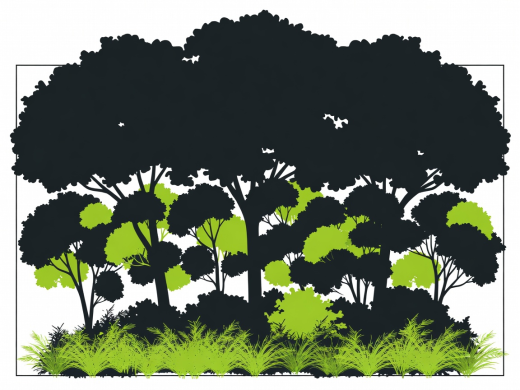
Three-Tier Spatial Section
Aim for a minimum bed depth of 1.8 to 2.4 metres behind the main seating arc. Shallow 600 mm perimeter strips only permit a single line of plants, which looks flat and leaves gaps at knee level.
Equatorial Originals vs. Cool-Climate Structural Equivalents
Select species according to your winter minimum temperatures while preserving identical silhouette geometry around the courtyard.
| Spatial Layer & Role | Frost-Free Tropics (USDA 10–11) | Warm Temperate (USDA 9 / RHS H4) | Cool Temperate (USDA 7–8 / RHS H5) | Acoustic & Spatial Note |
|---|---|---|---|---|
| Upper Canopy Overhead shade umbrella (2.5 m – 4.5 m) |
Cyathea cooperi (Australian tree fern), Archontophoenix cunninghamiana | Dicksonia antarctica, Butia odorata (Jelly palm) | Trachycarpus fortunei, Catalpa bignonioides 'Aurea' (pollarded) | Lift lower fronds above 2.1 m so standing players have clear head height. |
| Mid-Story Paddle Leaves Broad lamina sound scatter (1.2 m – 2.5 m) |
Musa acuminata 'Sumatrana', Heliconia bihai, Strelitzia nicolai | Ensete ventricosum 'Maurelii' (lifted or dry-mulched), Melianthus major | Musa basjoo (hardy banana), Tetrapanax papyrifer 'Rex', Fatsia japonica | Plant 1.1 m back from seat backs so wind-moved leaves do not slap microphones or hands. |
| Vertical Culm Screen Dense boundary baffle (2.0 m – 4.0 m) |
Bambusa textilis 'Gracilis' (Slender weavers bamboo) | Borinda papyrifera, Himalayacalamus hookerianus | Fargesia robusta 'Campbell', Fargesia murielae | Tightly spaced hollow culms break up lateral slap reflections; gentle leaf rustle masks distant road hum. |
| Ground & Plinth Layer Soil retention & edge absorption (0.2 m – 0.9 m) |
Philodendron burle-marxii, Xanthosoma sagittifolium | Colocasia esculenta 'Black Magic', Blechnum gibbum | Polystichum setiferum, Hosta 'Empress Wu', Asarum europaeum | Absorbs footstep crunch and stops rain splash from dirtying low-set cajón bases. |
Practical Foliage Decisions
Never plant leptomorph (running) genera such as Phyllostachys or Pleioblastus next to compacted gravel pads or timber decks without a 700 mm deep high-density polyethylene (HDPE) root barrier tilted 15 degrees outward. For stress-free courtyard design, specify pachymorph (clumping) genera like Fargesia in cool climates or Bambusa in warm zones, which expand slowly in tight, predictable crowns.
Keep armed plants—such as Phoenix roebelenii (sharp basal spine needles), Agave, or Pandanus—strictly out of the 1.2-metre circulation envelope. Likewise, avoid positioning fruiting figs or sticky sap-bleeding euphorbias directly above instrument benches where resin can stain porous goat or buffalo rawhide.
When herbaceous perennials like Musa basjoo are cut down by winter frost, the garden temporarily loses half its mid-story screening. Interplant deciduous bold foliage with evergreen structural anchors—specifically Fatsia polycarpa, Schefflera taiwaniana, and Fargesia—so the courtyard retains 60% of its visual and acoustic enclosure in January.