Leave Room for the Drum Circle
Playing rhythm outdoors is a pleasure when everyone has elbow clearance, clear eye contact across the circle, and confidence that sound is being managed respectfully toward neighbours.
Honest Outdoor Acoustic Physics
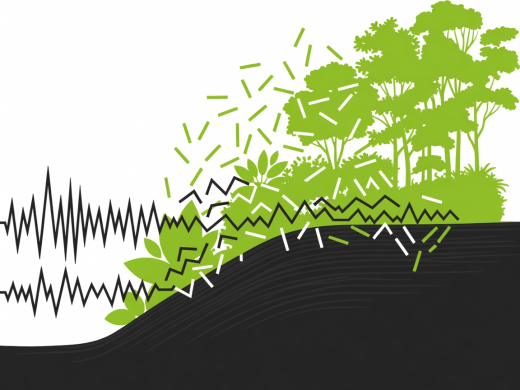
Garden owners frequently read exaggerated claims that planting a hedge will "block noise." According to outdoor acoustic propagation standards (such as ISO 9613-2 on sound attenuation during outdoor propagation) and empirical landscaping studies by the USDA National Agroforestry Center, vegetation affects sound in very specific, frequency-dependent ways:
- High-Frequency Scattering (1,000 Hz – 8,000 Hz): Dense, broad-leaved tropical foliage, rough bark, and deep leaf litter effectively scatter and absorb sharp transient sounds—the finger snaps of bongos, shaker beads, and woodblock clicks—reducing perceived harshness by 3 to 6 dB(A) over a deep planting belt.
- Eliminating Flutter Echo: In a walled courtyard, parallel brick or close-board timber fences bounce claps back and forth, creating a metallic ring. Placing irregular mounds of soil and multi-stemmed clumps of bamboo in front of hard fences breaks up specular reflections.
- Low-Frequency Reality (60 Hz – 250 Hz): Long-wavelength bass tones bend (diffract) effortlessly over standard 1.8-metre garden fences and pass straight through leaves. Only solid mass—such as a 450 mm earth berm, a heavy masonry garden room wall, or increasing distance from the boundary—attenuates deep bass.
Understanding this distinction lets you design intelligently: use earth shaping and corner orientation to direct sound away from adjoining homes, let lush foliage sweeten the mid-to-high timbre inside the court, and choose neighbour-friendly instrument voicings when houses sit close together.
Corner Orientation & Berm Geometry
Setting your seating pad 250 mm down into the ground and piling the excavated topsoil into a 600 mm contoured planting berm behind the players creates an immediate 850 mm solid earth acoustic shadow at instrument height.
Percussion Footprint & Clearance Schedule
Use these illustrative guidance dimensions (not regulatory requirements) when staking out your courtyard pad before laying edging steel.
| Instrument Configuration | Seated Footprint (W × D) | Arm & Stand Clearance Radius | Pad Surface Requirement | Neighbour Acoustic Profile |
|---|---|---|---|---|
| Seated Bongo Player (Clamped between knees or on stand) |
750 mm × 800 mm | 900 mm from seat centre | Any firm surface; bench height 470 mm | Low bass energy; crisp high martillo tones easily softened by surrounding foliage. |
| Cajón & Small Hand Percussion (Shakers, udu, kalimba, frame drum) |
700 mm × 750 mm | 850 mm from box centre | Flat, level stone or timber (avoid loose pea shingle under rubber feet) | Moderate punch; placing a 15 mm neoprene pad under the cajón decouples floor thump. |
| Single Djembe (12"–14" Head) (Tilted forward on strap) |
850 mm × 950 mm | 1,050 mm for wide arm strokes | Non-abrasive pad or woven outdoor mat to protect bottom carved ring | Strong open-tone projection and deep bottom port bass; best played with soft pads or rods in tight plots. |
| Twin Conga Setup (Quinto & Conga) (Seated on cradle or floor rubber rings) |
1,150 mm × 1,050 mm | 1,200 mm arc per player | Rigid, dead-level stone or deck platform so drums do not rock | Rich mid-bass warmth; orient open bottom shells toward thick soil berms rather than house patios. |
| Handpan / Tongue Drum / Marimba (Seated or low stand) |
900 mm × 900 mm | 1,000 mm clear space | Strict overhead shade mandatory (direct sun detunes nitrided steel within minutes) | Gentle, melodic harmonic sustain (65–72 dB at 1 m); ideal for dense urban courtyards. |
Practical Protocols for Outdoor Rhythm Sessions
1. Managing Rawhide vs. Synthetic Heads in Damp Gardens
Natural goat, calf, and water-buffalo skins are hygroscopic: they absorb moisture from damp evening air after you water your tropical beds, dropping pitch and losing crisp slap response. Conversely, leaving a tensioned djembe or bongo in hot sun dries and shrinks the skin, risking cracked shells or pulled flesh hoops. Always detour down-tension natural lugs by half a turn after an outdoor session, or equip dedicated garden drums with weather-resistant synthetic fiberskyn or tucked Nusantara heads.
2. The "Soft-Mallet & Brush" Urban Hour
Even in a well-planted courtyard, full-volume open slaps on a 13-inch djembe carry across quiet Sunday gardens. Keep a pair of felt-core bass mallets, woven rattan cajón brushes, and soft shaker pods in your garden locker. Switching from bare-hand open slaps to brushed cajón and handpan after 17:30 drops boundary sound pressure levels by 12 to 15 dB while keeping the rhythmic groove alive.
3. Respecting Local Environmental Noise Standards
Always align casual outdoor sessions with local residential nuisance guidelines (such as the UK Environmental Protection Act 1990 statutory nuisance framework or WHO Community Noise Guidelines, which recommend keeping outdoor living area averages below 50–55 dB LAeq during daytime hours). Speak with immediate neighbours ahead of larger weekend gatherings, share your usual finish time, and never use electronic amplification outdoors.